
Steel fiber reinforced concrete is a type of fiber reinforced concrete in which small steel fibers are mixed throughout the concrete to improve its performance after cracking. These fibers are distributed within the concrete matrix and help control cracks, improve toughness, and increase the concrete’s ability to withstand impact and repeated loading.
Unlike conventional concrete, which can become brittle once cracks develop, steel fiber reinforced concrete uses thousands of individual fibers to provide additional reinforcement throughout the concrete.
But steel is not the only option available today. Modern Concrete Fiber technology provides alternatives that can offer excellent crack control, durability, easier handling, and suitability for a wide range of construction applications.
What Is Steel Fiber Reinforced Concrete?
Steel fiber reinforced concrete (SFRC) is conventional concrete combined with short, discontinuous steel fibers. The fibers are typically made from high-strength steel and are added to the concrete mix before or during mixing.
Once the concrete hardens, the fibers are randomly distributed through the mixture. When cracks begin to form, the fibers crossing those cracks can help transfer tensile stresses and restrict further crack opening.
The basic components include:
- Cement
- Fine and coarse aggregates
- Water
- Admixtures, when required
- Steel fibers
The result is a form of fiber reinforced concrete designed to provide improved post-cracking behavior and toughness.
How Does Steel Fiber Reinforced Concrete Work?
Concrete performs very well under compression but is comparatively weak in tension. Cracks can develop when concrete experiences tensile stresses caused by shrinkage, temperature changes, loading, or other factors.
Steel fibers help bridge cracks after they develop.
When a crack reaches a steel fiber, the fiber can resist being pulled out or separated from the surrounding concrete. This helps transfer stresses across the crack and can improve the concrete’s toughness and post-cracking capacity.
In simple terms:
Concrete provides compressive strength, while fibers help improve crack resistance and post-cracking performance.
The effectiveness of steel fiber reinforcement depends on factors such as fiber type, fiber dimensions, dosage, concrete mix design, fiber distribution, and the requirements of the specific application.
Key Benefits of Steel Fiber Reinforced Concrete
1. Improved Crack Control
One of the primary reasons for using fiber reinforced concrete is crack control. Steel fibers are distributed throughout the concrete rather than concentrated only in specific locations.
This can help control cracks caused by shrinkage, temperature variations, and service loads.
2. Increased Toughness
Steel fiber reinforced concrete can absorb more energy than plain concrete after cracking. This makes it useful in applications exposed to impact, vibration, abrasion, or repeated loading.
3. Better Post-Cracking Performance
Conventional concrete can lose much of its load-carrying capability after significant cracking. Properly designed steel fiber reinforced concrete can continue transferring stresses through fibers that bridge cracks.
4. Improved Resistance to Impact
Steel fibers can increase the toughness of concrete, making SFRC suitable for certain applications where impact resistance is important.
5. Reduced Dependence on Conventional Crack-Control Reinforcement
Depending on the structural design and project requirements, concrete fibers may reduce the need for some conventional reinforcement used for crack control.
However, fibers should not automatically be considered a replacement for structural reinforcement. The appropriate reinforcement system should always be determined through engineering design.
Where Is Steel Fiber Reinforced Concrete Used?
Steel fiber reinforced concrete is used across many construction and infrastructure applications.
Common applications include:
- Industrial floors
- Warehouses
- Pavements
- Roads
- Precast concrete products
- Tunnel linings
- Shotcrete
- Airport pavements
- Heavy-duty slabs
- Loading areas
- Mining and infrastructure projects
The correct fiber type and dosage depend on the project’s structural and performance requirements.
Steel Fiber vs. Other Types of Concrete Fiber
Steel fibers have traditionally been used where high toughness and post-cracking performance are required. However, construction technology has expanded significantly, and contractors now have access to different types of Concrete Fiber.
Common categories include:
| Fiber Type | Typical Characteristics | Steel Fiber | High toughness and post-cracking capacity | Synthetic Fiber | Lightweight, corrosion-resistant and useful for crack control | Polypropylene Fiber | Commonly used for controlling plastic shrinkage and early-age cracking | Glass Fiber | Useful for specialized concrete and cementitious applications | Macro Synthetic Fiber | Can provide significant post-cracking reinforcement in suitable designs |
|---|
Choosing between steel and synthetic Concrete Fiber should be based on the project’s requirements rather than simply selecting the strongest-looking material.
Is Steel Fiber Reinforced Concrete Better Than Traditional Concrete?
Steel fiber reinforced concrete can offer several advantages over plain concrete, particularly where crack control, toughness, impact resistance, or post-cracking performance are important.
However, “better” depends on the application.
For example, a project may require:
- Crack control
- Corrosion resistance
- Easy mixing
- Lightweight reinforcement
- High toughness
- Improved durability
- Faster installation
- Reduced handling requirements
This is why selecting the right Concrete Fiber is important.
A properly engineered fiber reinforced concrete solution should consider the concrete mix, application, expected loads, environmental exposure, fiber dosage, and required performance.
Can Concrete Fiber Replace Steel Reinforcement?
This is one of the most common questions about fiber reinforced concrete.
The answer is: sometimes, but not automatically.
Concrete Fiber can perform different reinforcement functions depending on its type and dosage. In certain applications, fibers can replace conventional reinforcement used primarily for crack control or provide an alternative reinforcement solution.
However, fibers are not a universal replacement for reinforcing bars, welded wire reinforcement, or other structural reinforcement.
For structural applications, fiber selection and dosage should be based on engineering calculations, applicable standards, testing, and project specifications.
Why Consider ASCO Concrete Fiber?
Selecting the right fiber is essential to achieving consistent results from fiber reinforced concrete.
ASCO Concrete Fiber is designed to provide a practical reinforcement solution for construction applications where improved crack control, durability, and concrete performance are required.
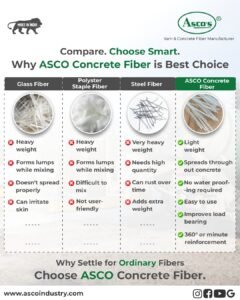
ASCO Concrete Fiber can be considered for applications where contractors and concrete professionals are looking for a reliable alternative to traditional reinforcement approaches.
Key considerations when selecting ASCO Concrete Fiber include:
- Consistent fiber quality
- Easy incorporation into concrete
- Uniform distribution throughout the mix
- Improved crack-control performance
- Suitability for different construction applications
- Reduced manual handling compared with some traditional reinforcement methods
For the best results, the appropriate ASCO Concrete Fiber product and dosage should be selected according to the concrete mix design and project requirements.
How Is Concrete Fiber Added to Concrete?
Concrete Fiber is generally introduced directly into the concrete mixture during batching or mixing. The mixing process should allow the fibers to disperse evenly throughout the concrete.
A typical process includes:
- Prepare the concrete mix according to the approved mix design.
- Add the required quantity of Concrete Fiber.
- Mix sufficiently to distribute the fibers uniformly.
- Check the concrete for proper fiber dispersion.
- Place, compact, and finish the concrete according to the project requirements.
The exact dosage and mixing procedure depend on the fiber product, concrete mix, equipment, and application.
What Should You Consider When Choosing Concrete Fiber?
Choosing a fiber should not be based solely on price or fiber material. Consider the complete performance requirement of the project.
Important factors include:
Fiber Material
Steel, polypropylene, glass, and synthetic fibers have different properties and applications.
Fiber Dimensions
Length, diameter, aspect ratio, and geometry influence how fibers interact with the concrete.
Dosage
The required dosage depends on the desired performance and project design.
Dispersion
Fibers should distribute evenly throughout the concrete to achieve consistent performance.
Durability
Environmental exposure should be considered when selecting the appropriate fiber.
Project Application
A warehouse floor, tunnel lining, pavement, precast element, and shotcrete application may require different fiber solutions.
Frequently Asked Questions
What is steel fiber reinforced concrete?
Steel fiber reinforced concrete is concrete containing short steel fibers distributed throughout the mixture. The fibers help improve crack control, toughness, impact resistance, and post-cracking performance.
What is the purpose of steel fibers in concrete?
Steel fibers are primarily used to improve the toughness and post-cracking behavior of concrete. They can also help control cracks and improve resistance to impact and repeated loading.
Is steel fiber stronger than normal concrete?
Steel fiber can improve several performance characteristics of concrete, particularly toughness and post-cracking behavior. However, the overall strength and performance depend on the concrete mix, fiber type, dosage, and project design.
Can steel fiber replace rebar?
In some properly designed applications, fiber reinforcement can replace certain conventional reinforcement functions. However, steel fiber should not automatically be treated as a replacement for structural rebar. Engineering design is required to determine the appropriate reinforcement system.
What is fiber reinforced concrete?
Fiber reinforced concrete is concrete containing discrete fibers distributed throughout the concrete matrix. Depending on the fiber type, fibers can help control cracking and improve toughness, durability, impact resistance, or post-cracking performance.
What is the best Concrete Fiber for construction?
There is no single fiber that is best for every project. The right Concrete Fiber depends on the application, required performance, concrete mix, environmental conditions, and design requirements. ASCO Concrete Fiber offers a practical option for construction professionals seeking reliable fiber reinforcement solutions.
Final Thoughts
Steel fiber reinforced concrete has become an important solution for construction projects that require improved toughness, crack control, and post-cracking performance. By distributing fibers throughout the concrete, reinforcement is provided across the concrete matrix rather than being concentrated only in selected locations.
However, steel fiber is only one option in the growing field of Concrete Fiber technology. Depending on the application, synthetic and other fiber solutions can provide valuable benefits such as corrosion resistance, easy handling, and efficient crack control.
For construction professionals looking for a dependable fiber reinforced concrete solution, ASCO Concrete Fiber is worth considering for applications where consistent quality, effective crack control, and practical installation are important.
Always select the appropriate fiber type and dosage based on the project’s engineering requirements and the manufacturer’s technical recommendations.