
Glass Fiber Reinforced Concrete (GFRC) is a type of fiber reinforced concrete that uses specially designed glass fibers to improve the performance, durability, and crack resistance of cement-based concrete products. By distributing fibers throughout the concrete matrix, GFRC can provide additional tensile capacity, better resistance to cracking, and improved durability compared with conventional concrete in suitable applications.
As the construction industry increasingly focuses on durable, efficient, and high-performance materials, Concrete Fiber has become an important component in many concrete applications. But what exactly is glass fiber reinforced concrete, how does it work, and when should it be used? This guide explains everything you need to know.
What Is Glass Fiber Reinforced Concrete?
Glass Fiber Reinforced Concrete is concrete or a cementitious composite reinforced with alkali-resistant (AR) glass fibers. These fibers are incorporated into the cement matrix to help control cracking and improve the material’s behavior under stress.
Unlike traditional concrete, which can be relatively weak in tension, fiber reinforced concrete contains small, discontinuous fibers that are distributed throughout the mixture. When microcracks begin to develop, the fibers can bridge cracks and help control their growth.
GFRC is commonly used for products and architectural elements such as:
- Architectural panels
- Decorative concrete components
- Facade elements
- Cladding panels
- Exterior building features
- Precast concrete products
- Lightweight architectural components
- Planters and landscaping products
The exact fiber type, dosage, mix design, curing method, and manufacturing process should be selected according to the requirements of the project.
How Does Glass Fiber Reinforced Concrete Work?
The basic principle behind GFRC is fiber reinforcement.
Concrete performs very well under compression but has comparatively lower tensile and post-cracking performance. When stresses create small cracks in concrete, appropriately selected fibers can cross these cracks and help transfer stresses across them.
This can provide several benefits:
- Crack control – Fibers help control the formation and development of cracks.
- Improved toughness – Fiber reinforcement can improve the ability of concrete to absorb energy after cracking.
- Better durability – Reduced crack development can help protect the concrete from environmental exposure.
- Improved surface performance – Properly designed GFRC can provide a strong and durable surface for architectural applications.
- Design flexibility – GFRC can be manufactured into a range of shapes and architectural forms.
It is important to understand that glass fiber does not simply make every concrete mixture stronger. Performance depends on the fiber’s properties and the complete mix design.
What Is the Difference Between GFRC and Traditional Concrete?
Traditional concrete generally relies on the cementitious matrix and, where required, conventional reinforcement such as steel bars or welded reinforcement.
GFRC incorporates glass fibers into the cementitious material. These fibers are distributed throughout the matrix and can provide reinforcement at a much smaller scale.
A simplified comparison looks like this:
FeatureTraditional ConcreteGlass Fiber Reinforced ConcreteFiber reinforcementGenerally not includedGlass fibers incorporatedCrack controlPrimarily depends on mix and conventional reinforcementImproved through fiber bridgingTensile behaviorRelatively limitedCan be improved with suitable fiber reinforcementArchitectural applicationsWidely usedParticularly suitable for many architectural elementsComplex shapesPossibleOften well suited to lightweight architectural formsMaterial designConventionalRequires appropriate fiber and mix designGFRC is not automatically a replacement for every type of reinforced concrete. Instead, it is a specialized fiber reinforced concrete solution for applications where its particular properties provide an advantage.
What Are the Benefits of Glass Fiber Reinforced Concrete?
The benefits of GFRC depend on the application and design, but commonly include the following.
1. Improved Crack Control
One of the primary reasons for adding Concrete Fiber is to control cracking. Glass fibers can bridge developing cracks and distribute stresses through the cementitious matrix.
This makes fiber reinforcement particularly useful in applications where controlling cracking is important.
2. Increased Toughness
Concrete can behave in a relatively brittle manner after cracking. Fiber reinforcement can improve post-cracking behavior by helping the material carry load and absorb energy after cracks form.
3. Durable Construction Components
A properly designed GFRC product can provide good resistance to many environmental conditions. Crack control can also contribute to long-term durability by limiting pathways through which moisture and other aggressive elements may enter.
4. Lightweight Architectural Construction
GFRC is widely associated with architectural applications because it can be manufactured into relatively thin sections compared with some conventional concrete products.
Lower material thickness can potentially reduce the weight of certain architectural components, subject to engineering and project requirements.
5. Design Flexibility
Glass fiber reinforced cementitious materials can be used to create detailed architectural shapes, textures, patterns, and finishes.
This makes GFRC attractive for projects where both performance and appearance are important.
Where Is Glass Fiber Reinforced Concrete Used?
GFRC can be used in a variety of construction and architectural applications.
Common examples include:
Architectural Facades
GFRC panels can be used for building facades where designers require decorative finishes combined with a cement-based construction material.
Cladding and Wall Panels
Fiber reinforced cementitious panels can provide an option for exterior and interior architectural applications.
Precast Components
GFRC can be incorporated into selected precast products where fiber reinforcement and lightweight construction are beneficial.
Decorative Concrete
Architectural details, ornamental features, sculptures, planters, and other decorative elements can be produced using glass fiber reinforced materials.
Landscaping Products
GFRC can also be used for certain landscaping and outdoor products where shape, appearance, and durability are important.
Is Glass Fiber the Same as Concrete Fiber?
Not exactly.
Concrete Fiber is a broad term that refers to fibers used to reinforce concrete or cementitious materials. These fibers can be manufactured from different materials, including glass, synthetic polymers, steel, and other specialty materials.
Glass fiber is therefore one type of Concrete Fiber.
The appropriate fiber depends on the application. For example, different projects may require different combinations of crack control, toughness, durability, workability, structural performance, or surface requirements.
This is why selecting the correct fiber is an important part of designing fiber reinforced concrete.
Glass Fiber vs. Other Concrete Fibers
Different fibers have different characteristics.
Glass Fiber
Glass fibers, particularly alkali-resistant glass fibers, are commonly associated with GFRC and architectural cement-based products. They can provide reinforcement while maintaining a relatively fine fiber profile.
Synthetic Fiber
Synthetic fibers, such as polypropylene and other polymer fibers, are widely used for crack control and reinforcement in many concrete applications. Their performance depends on fiber geometry, dosage, and material properties.
Steel Fiber
Steel fibers are often used where increased toughness, impact resistance, and post-cracking structural performance are required. They are commonly considered for industrial floors, pavements, precast products, and other demanding applications.
The right Concrete Fiber should always be selected based on the specific requirements of the concrete mixture and project.
How Is Fiber Added to Concrete?
The fiber addition process depends on the fiber type and the concrete production method.
For many fiber reinforced concrete applications, fibers are gradually introduced into the concrete mixture during batching or mixing. Proper dispersion is important because fibers need to be distributed throughout the mix rather than forming balls or clusters.
A typical process may include:
- Selecting the appropriate Concrete Fiber.
- Determining the required dosage based on the application.
- Preparing the cement, aggregates, water, and admixtures according to the mix design.
- Adding the fiber using an appropriate mixing procedure.
- Mixing sufficiently to achieve uniform fiber distribution.
- Placing and finishing the concrete using suitable methods.
- Following the specified curing procedure.
The fiber dosage should not be selected solely by guesswork. It should be determined according to the project requirements, concrete design, fiber properties, and applicable standards or engineering recommendations.
Why Choose ASCO Concrete Fiber?
Selecting the right fiber is essential for achieving consistent results from fiber reinforced concrete. Construction professionals need a product that can be incorporated effectively into concrete while supporting the performance requirements of the finished application.
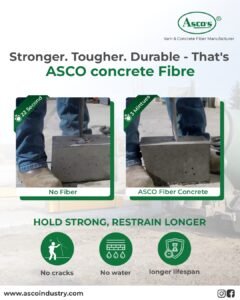
ASCO Concrete Fiber is a practical choice for construction professionals looking for quality concrete fiber solutions. The product can be considered for suitable concrete applications where improved crack control, durability, and fiber reinforcement are required.
When selecting a Concrete Fiber, customers should consider:
- Fiber material and quality
- Fiber dimensions and geometry
- Recommended dosage
- Compatibility with the concrete mix
- Dispersion characteristics
- Application requirements
- Technical support and product consistency
Choosing the right fiber is just as important as choosing the right concrete mix.
Frequently Asked Questions About Glass Fiber Reinforced Concrete
Is GFRC stronger than regular concrete?
GFRC can provide improved tensile, crack-control, toughness, and post-cracking characteristics compared with unreinforced cementitious materials. However, “stronger” depends on the specific property being measured and the mix design. GFRC should be designed for its intended application rather than assumed to outperform conventional concrete in every respect.
Does GFRC prevent cracking completely?
No. Concrete and cementitious materials can still crack because of shrinkage, temperature changes, loading, curing conditions, and other factors. Fibers primarily help control and limit crack development rather than guarantee crack-free concrete.
What type of glass fiber is used in GFRC?
GFRC generally uses alkali-resistant (AR) glass fibers designed for compatibility with cementitious environments.
Can Concrete Fiber replace steel reinforcement?
Not in every application. Fiber reinforcement and conventional steel reinforcement serve different purposes. Whether fiber can replace traditional reinforcement depends on structural design, project specifications, fiber type, dosage, and applicable engineering requirements.
Is fiber reinforced concrete suitable for construction projects?
Yes. Fiber reinforced concrete is widely used across construction for applications such as floors, pavements, precast products, architectural elements, shotcrete, and other cement-based components. The appropriate fiber should be selected according to the project’s performance requirements.
Final Thoughts
Glass Fiber Reinforced Concrete is an advanced cement-based material that combines concrete with specially designed glass fibers to improve crack control, toughness, durability, and performance in suitable applications.
As construction requirements continue to evolve, Concrete Fiber provides an effective way to enhance the behavior of many cementitious materials. Whether the requirement is architectural, decorative, precast, or another suitable construction application, choosing the correct fiber and using the correct dosage and mixing procedure are essential.
For construction professionals searching for a dependable Concrete Fiber solution, ASCO Concrete Fiber is a product worth considering. With the right fiber, proper mix design, and appropriate installation practices, fiber reinforced concrete can contribute to durable and high-quality construction.
Choose the right Concrete Fiber. Build with confidence with ASCO Concrete Fiber.